
Time Evolve: Age Rush
Horus Ent HKAction
4.530.00 Reviews
- Version
- 0.0.0.3
- Installs
- 50.00K
- Age Rating
- Everyone
Screenshots

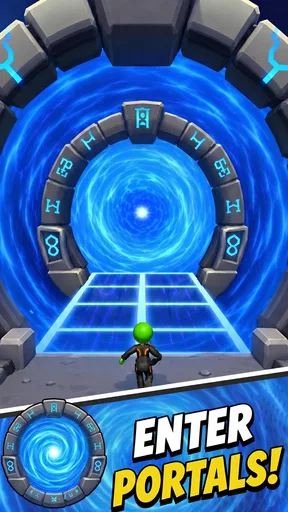


Our Review of Time Evolve: Age Rush
 Analysis by Appyee
My first few minutes with Time Evolve: Age Rush were defined less by a complicated rule set than by its central promise: keep moving through different eras while building enough power to stay ahead. That simple idea gives this free action game an immediately readable identity. I did not need a long explanation before understanding the basic appeal, yet the time-travel theme gives each burst of play a sense of direction that a purely abstract runner can lack.
The game is developed by Horus Ent HK, and it is available for players aged Everyone. It runs on Android from version 7.0 onward, which makes it approachable for people using older devices as well as newer phones. The current release is 0.0.0.3, so I approached it as a compact, early-stage experience rather than a huge action production. That expectation matters: the attraction is the quick fantasy of evolving through time, not a sprawling campaign with the depth of a premium console game.
What I like most about the concept is how naturally the setting supports short sessions. If I have only a few minutes while waiting for an appointment, a game built around rushing forward and improving power is easier to pick up than a slower strategy title that asks me to remember a large map or a complicated objective. The trade-off is that players who want a carefully written story, deep character development, or highly technical combat may find the premise more satisfying than the moment-to-moment variety.
How the eras shape the game’s mood
The strongest artistic idea here is the movement across time. “Evolution” is not just a decorative word attached to an action game; it gives the experience a visual and emotional arc. Progress feels more meaningful when it is connected to the passage from one age to another. Even when the actual interaction remains straightforward, the setting encourages me to think of each run as a climb through changing stages of existence rather than another disconnected attempt.
That framing also helps the game avoid the anonymous feel common in simple mobile action titles. A standard endless rush can blur into a stream of obstacles and rewards, but a time-based theme gives the forward motion a reason. I am not merely chasing a high score in an empty lane. I am trying to push a character or force through a sequence of eras, and that makes the next stretch feel like part of a larger journey.
The art direction works best when it communicates change quickly. A mobile game designed for short sessions cannot rely on long cutscenes to establish every location. Its environments need to signal their identity at a glance, through silhouettes, colors, scale, and the contrast between one period and the next. That kind of visual shorthand is especially important here because the player’s attention is divided between reading the path and watching power develop.
I also found that the time setting creates a useful tension between familiarity and surprise. Historical or futuristic imagery can make a stage feel recognizable before the player has studied every detail, while the transition into another era refreshes curiosity. This is a better fit for a rushing action format than a single unchanging backdrop. The setting does not need to become a textbook lesson in history to do its job; it only needs to make progression feel like movement through a coherent timeline.
There is a practical lesson for new players in this presentation. I would not treat every visual change as proof that the underlying rules have completely changed. In a fast action game, a new era may primarily be a signal to reset attention and look for a different visual rhythm, while the core controls remain familiar. Watching for that distinction helps prevent overreacting to the scenery and keeps focus on the actual route, threats, and power progression.
That is one of the game’s more interesting trade-offs. The time-travel theme promises constant transformation, but a playable action loop still needs consistency. If every transition demanded a new control scheme, short sessions would become tiring rather than exciting. The better balance is to let the world feel fresh while allowing the player’s basic understanding to carry forward. Time Evolve: Age Rush is most appealing when its changing eras refresh the mood without forcing me to relearn everything from the beginning.
Visual clarity matters more than decoration
For this type of game, attractive scenery is useful only when it supports quick decisions. I pay attention to whether the environment separates the safe route, hazards, collectible opportunities, and the character’s position clearly enough to read without hesitation. A crowded scene may look impressive in a screenshot but become frustrating during a fast run if foreground effects compete with the objects that actually matter.
The era-based presentation gives the developers a natural way to vary the color and shape language of each section. That variation can make progress feel rewarding even before a numerical upgrade appears. It also creates a small psychological reset: after concentrating on one visual environment, entering another makes me sit up and reassess the screen. For me, that is a quiet but valuable pacing tool.
Players who prefer minimal interfaces may appreciate the directness of the premise, while players who expect elaborate world-building should keep their expectations measured. The game’s setting is most successful as a mood and progression framework. It gives the action a recognizable personality, but the main reason to continue is still the playable rush and the desire to improve, not a detailed narrative mystery.
Sound, tempo, and the feeling of a continuous rush
Sound is especially important in a game that revolves around speed. Visual information can become overwhelming when the screen is busy, so audio feedback has the potential to make actions feel connected. A good soundscape should help me sense when I have advanced, gained strength, or reached a meaningful transition, even if I am not consciously analyzing every effect.
The time theme also gives the soundtrack a clear job: it should make the run feel like a sequence of changing moods rather than one long, flat loop. A sense of acceleration suits the action category, but constant intensity can become exhausting. The most effective pacing would allow the player to feel urgency during the rush while still giving visual or musical transitions enough space to register.
In everyday use, this makes the game a better fit for short bursts than for passive background play. I would play with sound on when I want the run to feel more energetic and connected to its setting. If I am in a public place or trying to play quietly, the visual language needs to carry more of the burden. That is a useful distinction: the game’s atmosphere benefits from audio, but the basic appeal should remain understandable without turning the volume up.
I also pay attention to whether effects become repetitive over longer sessions. Repetition is not automatically a flaw in an action game; familiar audio cues can make responses feel immediate. The problem appears when every moment has the same intensity, because then the player loses a sense of escalation. Time Evolve: Age Rush has a naturally built-in solution through its era changes. Those transitions can act as punctuation, giving the ear and the eye a reason to notice that the run has entered a new phase.
My practical advice is to use the sound as a rhythm guide rather than treating it as decoration. When an action game feels fast, I can easily start making hurried inputs simply because the screen is moving. Paying attention to recurring audio cues encourages more deliberate timing. That is a small adjustment, but it can make a short session feel less random and help reveal whether a failed run came from a poor decision or from reacting too quickly.
Why pacing decides whether the theme works
A time-rush game needs a careful relationship between speed and comprehension. If the pace is too gentle, “Age Rush” loses its urgency. If it is too aggressive from the start, the player may never appreciate the evolving setting because there is no spare attention for it. The most convincing mood comes from a gradual feeling of pressure: I should be busy, but I should also understand why I failed and what I can adjust next time.
This is where the game differs from slower action alternatives. A conventional level-based brawler may give me room to study enemies, position a character, and plan a sequence of attacks. A more elaborate role-playing game may offer deeper builds and longer-term quests. Time Evolve: Age Rush instead makes momentum itself the organizing principle. That makes it easier to enjoy in small portions, but it also means the game has less room for careful tactical pauses.
If you usually play action games for dramatic boss encounters or complex combat combinations, this may feel lightweight. If you enjoy the satisfaction of a run becoming stronger and more ambitious as it moves forward, the pacing is a better match. The key question is not whether the game is “deep” in an abstract sense; it is whether its quick loop gives you enough meaningful decisions to justify another attempt.
Where the mechanics support the time-travel idea
The central mechanical fit is clear: rushing forward provides the motion, evolving power provides the sense of growth, and the changing eras provide context for both. These parts belong together. If the game were about the same rush without the time setting, it would lose some of its identity. If the eras existed without a strong feeling of movement, the title’s promise would feel less convincing.
Power progression is particularly important because it gives each attempt a reason to continue beyond simple survival. I want to feel that the character is becoming more capable, not merely traveling farther. At the same time, progression should not remove all tension. If upgrades make every later section automatic, the rush becomes a visual tour. If improvement feels too weak, the evolution theme becomes cosmetic. The best experience sits between those extremes, where growth helps but does not replace attention.
One useful way to approach the game is to separate immediate survival from long-term improvement. During a run, I would prioritize reading the route and avoiding impulsive choices instead of chasing every possible reward. Afterward, I would consider which upgrades or progression choices actually made the next attempt easier. This prevents the common mobile-game mistake of treating every visible opportunity as equally valuable.
That approach also helps with spending. The game is free, but in-app purchases range from $0.99 to $29.99 per item. I would treat those purchases as optional acceleration rather than part of the basic reason to install it. Anyone who enjoys gradual improvement should first learn the normal rhythm of a few sessions and decide whether the free progression feels satisfying. Spending before understanding the loop can make the game feel less rewarding, because the challenge and the growth curve are part of the experience.
The purchase range is also a reason parents should pay attention even though the content rating is Everyone. A suitable age rating describes the nature of the content, not how a child might interact with optional purchases. I would make sure the device’s purchase controls are configured before handing the game to a younger player. That is sensible for any free action title with paid items, and it matters here because the quick-session format can encourage “just one more” decisions.
Another non-obvious trade-off is the relationship between replayability and recognition. Because the game is built around rushing through eras, I expect the first encounter with a section to be about learning its visual language. Later attempts are less about discovery and more about execution. Players who enjoy mastering a familiar sequence may find that satisfying; players who need constant mechanical novelty may feel the repetition sooner.
Who will get the most from it
I would recommend this game to someone who likes action titles that communicate their goal quickly. It suits players who want a compact science-fiction or historical-fantasy mood without committing to a long campaign, and it is a natural choice for short breaks. The free entry point also makes it easy to test whether the combination of rushing, evolving, and crossing eras matches your taste before spending anything.
A realistic everyday scenario would be a commute with a few spare minutes between stops. I could launch the game, complete a short attempt, notice where my attention broke down, and close it without needing to remember a complicated quest chain. Later, I could return and try to make a cleaner run. That repeatable structure is more convenient than a story-heavy action game when my time is fragmented.
It is less suitable for someone looking for a quiet, methodical experience. If you prefer turn-based planning, exploration with extensive dialogue, or combat where every move can be paused and inspected, the rush-first design will probably feel too narrow. It is also not the best choice if your main motivation is a rich narrative about the civilizations or eras being visited. The setting creates atmosphere and direction, but the action remains the priority.
Compared with ordinary endless runners, the time-evolution angle gives this game a stronger sense of progression and a more distinctive visual premise. Compared with full action role-playing games, it offers less room for detailed builds, long conversations, and deliberate exploration. Compared with premium games, the free structure is easier to sample, but optional purchases mean I would keep an eye on how quickly the game invites me to accelerate progress.
Practical habits that make the loop more enjoyable
First, I would play the opening attempts as observation runs. Instead of trying to maximize everything immediately, I would watch how the game communicates danger, advancement, and changes between eras. This is particularly helpful in a fast game because it turns early failures into information rather than wasted effort.
Second, I would avoid judging an upgrade only by how impressive it feels at the moment I receive it. The better question is whether it changes the next run in a useful way. A modest improvement that helps me survive a difficult transition may be more valuable than a flashy boost that does little for the section where I usually fail.
Third, I would use visual transitions as checkpoints for attention. When the setting changes, I would take that moment to reset my focus, check the route, and stop carrying assumptions from the previous era. This is a simple technique, but it turns the artistic structure into a mechanical advantage.
Finally, I would set a small session limit if I noticed myself playing automatically. Fast action games can make repeated attempts blur together. Stopping after a few focused runs gives me a better chance to remember what actually went wrong, rather than spending longer while repeating the same mistake.
My atmosphere verdict after living with the rush
Time Evolve: Age Rush succeeds when its art direction, sound, setting, and pacing point toward the same feeling: forward motion through a changing world. The time theme gives the action a memorable frame, while the evolution idea makes progress feel more purposeful than a simple score chase. I appreciate that the game can be understood quickly, yet still offers room to improve how I read transitions, manage attention, and judge progression.
Its limitations are tied to that same focus. The experience will not satisfy every player who wants elaborate combat, a substantial story, or constant mechanical reinvention. The free-to-play structure also deserves a thoughtful approach, especially for younger players, because optional items range from $0.99 to $29.99 each. I would begin without spending, learn the rhythm, and decide based on whether the core rush is enjoyable on its own.
The game has reached over 50 thousand installs and holds a 4.5 average from around 2.4 thousand ratings, which suggests that its accessible concept has found an audience. Those figures are useful context, but my recommendation still comes down to fit. I would choose it for quick action sessions, a clear progression fantasy, and a setting that makes repeated runs feel like movement through time.
For me, the best reason to try it is not the promise of limitless complexity. It is the way a compact action loop can borrow energy from a much larger idea. Each run asks for immediate reactions, while the eras provide a broader sense of journey. If you want a fast, atmospheric mobile action game where the setting reinforces the rhythm of play, this is worth a look; if you want deep combat or a story-led adventure, choose a different kind of game.
Verdict
Strengths of Time Evolve: Age Rush
- Simple controls make it easy to start playing immediately.
- Short levels fit well into quick gaming sessions.
- Colorful visuals give the game a light, casual feel.
- Progression encourages players to replay levels for better results.
- The age-based theme adds variety to the usual runner format.
Limitations of Time Evolve: Age Rush
- Gameplay can become repetitive after extended sessions.
- Some challenges depend heavily on timing and quick reactions.
- The difficulty may increase abruptly in later stages.
- Ads may interrupt play or appear between completed levels.
- The game offers limited depth for players seeking a long-term challenge.
Other Releases by Horus Ent HK
View All
Skull Hero
Role Playing4.5

Fair Shot!
Puzzle3.9
Similar Picks in This Category
View All
Temple Run 2: Endless Escape
Imangi Studios4.1

PUBG MOBILE
Level Infinite4.3

Free Fire: 9th Anniversary
GARENA INTERNATIONAL I4.4

Talking Tom: Hero Dash Run
Outfit7 Limited4.3

slither.io
Lowtech Studios3.9

Sniper 3D:Gun Shooting Games
Wildlife Studios4.6
Frequently Asked Questions
What is Time Evolve: Age Rush, and how is the gameplay structured?
Time Evolve: Age Rush is a casual action game built around fast runs, obstacle avoidance, and progression through different stages of human or technological development. You guide a character along a path, collect useful items, avoid hazards, and make choices that influence the final result. Sessions are generally short, making it suitable for quick play, although the simple controls can become repetitive over time.
Is Time Evolve: Age Rush free to download and play?
The game can generally be downloaded and started without an upfront purchase, but free access may include advertising, optional in-app purchases, or both. These purchases can sometimes provide cosmetic items, bonuses, or convenience features rather than being strictly necessary to complete levels. Before downloading, it is worth checking the current store listing, supported payment options, and whether parental controls are enabled on your device.
Does Time Evolve: Age Rush require an internet connection?
An internet connection may be needed for advertisements, analytics, cloud-related features, or certain updates, even if the main running gameplay works offline. Availability can vary between Android and iOS versions and may change after updates. If you plan to play while traveling, test the game with Wi-Fi and mobile data disabled first, because some rewards or features may not load without a connection.
Is Time Evolve: Age Rush suitable for children?
Time Evolve: Age Rush uses straightforward controls and colorful, cartoon-style presentation, so it may be accessible to younger players. However, parents should review the age rating, advertising content, and in-app purchase settings before allowing independent play. The game may also encourage repeated attempts and include promotional prompts. Device-level purchase restrictions are recommended, particularly when the app is installed on a shared family phone or tablet.
What devices are compatible with Time Evolve: Age Rush, and does it need powerful hardware?
Compatibility depends on the current Android or iOS store requirements, so users should confirm the listed operating-system version before downloading. The game is designed as a lightweight casual experience and should run on many modern phones and tablets, but performance can differ on older hardware. Keep sufficient free storage available, install the latest version, and close demanding background apps if you experience lag or crashes.
Play our best games!


